
Compliance Architecture
NUSDpay has a built-in professional compliance engine that provides automated transaction monitoring and risk assessment capabilities.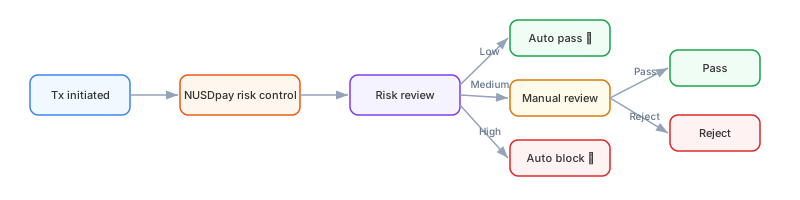
Risk control review flow (click to enlarge)
KYA — Know Your Address
Know Your Address (KYA) technology performs risk assessments on the blockchain addresses involved in transactions:- Address Profile: Identifies the type of entity to which the address belongs (exchange, mixer, darknet, sanctions list, etc.)
- Risk Score: Generates a risk score based on the address’s historical behavior
- Real-Time Screening: Automatically screens the target address of every Payin/Payout transaction
KYT — Know Your Transaction
Know Your Transaction (KYT) technology performs real-time monitoring of every transaction:- Transaction Screening: Automatically analyzes dimensions such as transaction amount, frequency, and counterparties
- Risk Rating: Three-level classification: High Risk / Medium Risk / Low Risk
- Post-Processing Policies: Triggers automatic approval, manual review, or interception based on the risk level
Screening Flow
Payin Screening
For every deposit by an end user, the system automatically performs:1
On-chain transaction detection
After NUSDpay detects a deposit transaction, it extracts the sender’s address and transaction information.
2
KYA address screening
Performs risk profiling on the sender’s address to check whether it is associated with sanctions lists, mixers, or other high-risk entities.
3
KYT transaction screening
Analyzes dimensions such as transaction amount, frequency, and route to generate a risk rating.
4
Risk handling
- Low Risk: Automatically credited
- Medium Risk: Enters the manual review queue
- High Risk: Automatically frozen, awaiting handling by the compliance team
Payout Screening
For every payment initiated by a merchant, the system automatically performs:- KYA screening of the recipient address (address whitelist + risk profile)
- KYT analysis of transaction amount and frequency
- When risk control rules are triggered, the transaction enters review status (Webhook notification Sub-Status:
PendingAML/KYCReview)
Screening Results
Post-Screening Policies
NUSDpay supports configuring Post-Screening Policies that automatically perform corresponding actions based on the risk rating:Post-Screening policies can be customized in the risk control module of the admin console.
API Security
Request Signature
All API requests use the Ed25519 signature + nonce anti-replay mechanism:- Each request carries a unique nonce (timestamp)
- The request body is signed with the Ed25519 private key
- The server verifies the signature + checks nonce validity to prevent replay attacks
Webhook Security
The Webhook notifications pushed by NUSDpay are also protected by signatures:- Each Webhook carries a signature header, so merchants can verify the message source
- We recommend responding within 2 seconds; the system automatically retries on timeout
- Use
request_idfor idempotent handling to prevent duplicate consumption
Security Best Practices
Key management
Key management
- The private key should only be used on the server side; do not hardcode it in front-end code
- Rotate API keys regularly
- Store keys using environment variables or a secrets management service
Network security
Network security
- All API communication must use HTTPS
- We recommend configuring an IP allowlist to restrict API call sources
- We recommend configuring HTTPS + signature verification on Webhook endpoints
Access control
Access control
- Follow the principle of least privilege; assign console permissions by role
- Sensitive operations (settlement, transfer) require secondary verification with a code
- Audit operation logs regularly
Next Steps
Transaction Status Reference
Learn the meaning of each status and sub-status, including AML review-related statuses.
Webhook Configuration
Configure Webhooks to receive transaction and compliance review notifications.